A customer fills out your quote request form at 9:40 on a Tuesday morning. You're mid-job, or with another customer, or just haven't looked at your inbox yet. By the time you reply that afternoon, they've already booked with the business that got back to them in ten minutes.
New business often disappears in the gap between "someone showed interest" and "someone from your business responded." The fix isn't working faster or checking your phone more often. It's an automated workflow that acknowledges and routes every new lead the instant it arrives, shrinking the delay between interest and response from hours to minutes even when you're not looking at a screen.
The lead you don't see yet is already losing value
The research is old enough to be settled, and follow-up studies point in the same direction, even if any single multiplier deserves skepticism. According to the landmark Lead Response Management study analysis, the odds of contacting a lead in 5 minutes versus 30 minutes drop by 100 times, and the odds of qualifying a lead in 5 minutes versus 30 minutes drop 21 times. The odds of calling to contact a lead decrease by over 10 times in the first hour alone.
Despite the proven impact of speed-to-lead, real-world execution remains surprisingly poor. In a secret-shopper audit of 433 B2B SaaS companies by Drift, only 7% of companies responded within 5 minutes, while 55% took longer than 5 business days to reply at all.
Neither study is about phone calls that ring and go unanswered. They are about the quieter version of the same problem: a form submission, a chat message, or an email inquiry that sits untouched because no one happened to be looking at it when it landed.
Why "I'll get to it today" already costs you
The instinct to treat a web inquiry like a piece of mail, something you'll deal with when you get a free moment, is understandable. Nothing about a form submission feels urgent the way a ringing phone does. But the person on the other end doesn't experience it that way. They filled out that form because they have a problem now, and in most cases they filled out two or three more like it with competing businesses in the same sitting. Whoever answers first isn't just first; they're often the only one who gets a real look before the customer picks someone and stops checking their inbox.
If you've never measured it directly, this is easy to underestimate: the lead doesn't sit there waiting patiently for you to have a slow afternoon. It decays. By the time you reply, the person may have already booked elsewhere, solved the problem another way, or simply lost the urgency that made them reach out in the first place.
What an automated response workflow does
This isn't about hiring someone to sit by the inbox all day, and it isn't the same as automating the busywork of copying a booking into your invoicing software, which is a separate and worthwhile problem. It's built to close the response gap when a lead arrives, before a human needs to get involved:
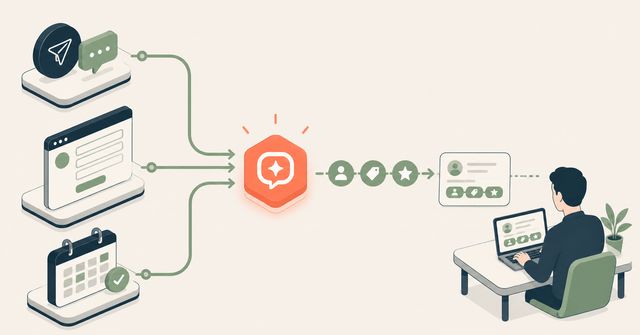
A new form submission, chat message, or booking request triggers an immediate, personalized acknowledgment, sent within seconds instead of whenever someone checks their phone. That message can confirm the details the customer entered, set an honest expectation for when a real reply is coming, and in some cases start answering their question using information pulled from your own pricing, availability, or service details rather than a generic template.
After that first message, the workflow routes the lead to the right person or list based on what they asked for and tags it with useful context so nothing gets lost. If no human response happens within a set window, it sends a follow-up nudge automatically so the lead never just goes silent. None of this replaces the judgment a person brings to a sales conversation. It closes the gap between the moment someone raises their hand and the moment your business visibly shows up, which is the exact window where the research above says the most value is won or lost.
What this looks like for a real business
Picture a photography studio that gets inquiries through an Instagram DM, a website contact form, and a booking widget, all feeding into different places. Right now, whichever one the owner happens to check first gets a reply, and the other two wait. A workflow can pull all three into one place, send an instant acknowledgment with the studio's availability and package details, and flag anything urgent for same-day human follow-up. Every inquiry gets the same fast first touch, regardless of which channel it came through or how busy the owner's day already is.
This is a narrower slice of broader workflow automation, but it deserves its own attention because the cost of getting it wrong is direct and measurable: leads you already paid to generate, or already earned through your reputation, going to a competitor simply because they answered first.
Key Takeaways
- Research on lead response time consistently shows that contact and qualification odds drop sharply within the first 30 minutes to an hour after a lead comes in, even though the exact multipliers vary by study and should be treated as directional.
- A real-world test of hundreds of companies found that most take far longer than five minutes to respond to a new inquiry, and a substantial share never respond at all.
- The problem isn't unanswered phone calls, it's web forms, chat messages, and booking inquiries that sit untouched until someone happens to check them.
- An automated response workflow sends an immediate acknowledgment and routes the lead the instant it arrives, closing the gap between interest and reply without requiring someone to watch the inbox all day.
- This is a specific application of workflow automation focused on response speed, distinct from automating data entry between existing business tools.
Mindstate Strategy builds automated lead-response workflows that connect to your existing forms, chat, and booking tools so every new inquiry gets an immediate, accurate reply. Learn more about our workflow automation services or get in touch through our contact page to talk through what a faster response workflow would look like for your business.